

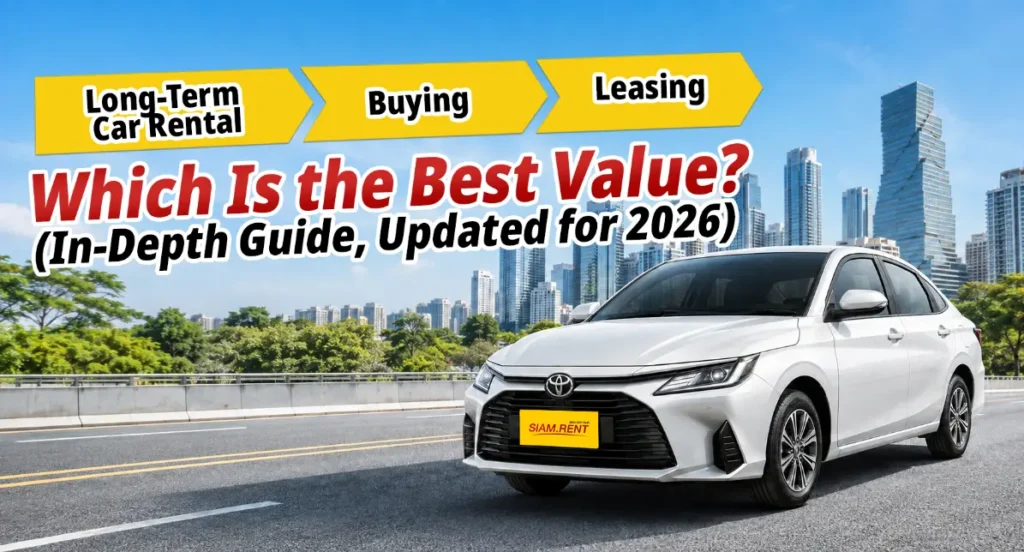
Long-Term Car Rental vs Buying vs Leasing: Which is the Best Value? (2026 In-Depth Update)
Managing capital and cash flow is the heart of living and running a business today. Especially in 2026, with rapid changes in the economy and automotive technology, deciding how to acquire a vehicle—whether for personal use or organizing a corporate fleet—is no longer limited to just “buying with cash” or “auto financing (hire purchase).”
Today, vehicle access models are much more diverse. A highly debated question among individuals and organizations is: “Long-term car rental vs. Buying vs. Leasing—which offers the best value?” In this article, Siam.Rent will take you on a deep dive comparing every dimension. We will look at hidden costs, maintenance burdens, and corporate tax benefits, equipping you with the latest data to make the most accurate and cost-effective decision for every baht spent.
Table of Contents
- Understanding the Basics: Buying vs. Leasing vs. Long-Term Rental
- Head-to-Head Comparison Table
- Deep Dive: Pros & Cons of “Buying a Car” (Cash and Hire Purchase)
- Deep Dive: Pros & Cons of “Car Leasing”
- Deep Dive: Pros & Cons of “Long-Term Car Rental” (Operating Lease)
- Corporate Tax and Car Usage in 2026: An In-Depth Case Study
- 5 Key Factors to Help You Decide Easily
- Why Choose Long-Term Car Rental with Siam.Rent?
- Frequently Asked Questions (FAQ)
- Restructure Tax & Reduce Hidden Costs with Long-Term Car Rental
Understanding the Basics: Buying vs. Leasing vs. Long-Term Rental
Before we compare the pros, cons, and accounting figures, we need to understand the fundamentals of all three models, as each carries completely different legal conditions and ownership structures.
1. Buying a Car (Cash / Hire Purchase)
Buying a car can be done via cash or hire purchase (financing). When you pay in cash, you gain 100% ownership immediately. With a hire purchase, the finance company holds the ownership until you pay off the installments. You are responsible for all expenses related to the car, including insurance, compulsory motor insurance (Por Ror Bor), vehicle tax, scheduled maintenance, and you carry the risk of the car’s resale value depreciating over time.
2. Car Leasing (Financial Leasing)
Leasing is highly popular among corporate entities (SMEs and Corporates). It is similar to a hire purchase but differs in tax structure and accounting. Ownership remains with the leasing company throughout the contract (usually 3-5 years), and the lessee pays a monthly fee. At the end of the contract, the lessee has a “Call Option” to buy the car at a pre-agreed balloon or salvage price. However, the lessee still bears the burden of maintenance and insurance costs in most cases.
3. Long-Term Car Rental (Operating Lease)
Long-term car rental, or an operating lease, is strictly for “usage.” The rental company (like Siam.Rent) retains ownership and assumes all risks. The lessee simply pays a fixed monthly rate throughout the 1-5 year contract. This rental fee covers everything: 1st-class insurance, vehicle tax, compulsory insurance, tire and battery replacements, and all scheduled maintenance. If the car breaks down or is in an accident, a replacement vehicle is provided. When the contract ends, you simply return the car or sign a new contract for a brand-new vehicle.
Head-to-Head Comparison Table: Rental vs. Buying vs. Leasing
| Comparison Factor | Buying (Cash/Hire Purchase) |
Leasing (Financial Lease) |
Long-Term Rental (Operating Lease) |
|---|---|---|---|
| Ownership | Belongs to the buyer (after payoff) |
Belongs to the leasing company | Belongs to the rental company |
| Down Payment / Initial Investment |
High down payment required (15-25%) |
Only 1-2 months security deposit | Only 1-2 months security deposit |
| Maintenance / Insurance / Tax | Buyer bears 100% of the costs | Lessee bears the costs (mostly not included) |
FREE! All-inclusive in the monthly rent |
| Replacement Vehicle | None | None | Replacement vehicle provided |
| Tax Benefits (Corporate) |
Depreciation deduction up to 1,000,000 THB |
Expense deduction up to 36,000 THB/month/car |
Expense deduction up to 36,000 THB/month/car |
| Accounting / Balance Sheet | Recorded as Asset & Liability (Increases D/E Ratio) |
Recorded as Right-of-use Asset & Liability | Recorded as Operating Expense (Does not affect D/E) |
| End of Contract | Keep using, sell, or trade-in | Option to buy at salvage price, or return | Return the car, option to renew for a new car |
Deep Dive: Pros & Cons of "Buying a Car"
Many believe a car is an asset. In reality, it is a rapidly depreciating asset. Especially in 2026, with the used car market highly volatile due to the influx of Electric Vehicles (EVs), the resale value of combustion engine cars has noticeably dropped.
- Pros: Total pride of ownership. You can modify, decorate, or install accessories freely. There are no mileage limits. It’s ideal if you plan to use the same car for over 7-10 years.
- Cons: Requires a large chunk of cash for a down payment, creating an opportunity cost. You bear all hidden costs: annual tax renewals, rising 1st-class insurance premiums, scheduled maintenance, and tire changes. Once the warranty expires (usually 3-5 years), repair costs jump significantly. Most importantly, when it’s time to sell, you face a 50-60% depreciation from the original price.
Deep Dive: Pros & Cons of "Car Leasing"
Leasing is a compromise between renting and buying, heavily focused on corporate clients seeking tax benefits.
- Pros: No large down payment required, helping companies maintain liquidity. Monthly payments can be deducted as a corporate expense for tax purposes up to 36,000 THB/month (for passenger cars with up to 10 seats). A key advantage is the option to buy the car below market price at the end of the contract, often used as an executive or employee perk.
- Cons: Monthly leasing costs usually do not cover maintenance, tax, insurance, and tires (depending on the contract). This means your Procurement or HR department still wastes time managing servicing and insurance claims, adding hidden operational costs to your business.
Deep Dive: Pros & Cons of "Long-Term Car Rental"
Long-term rental is a rapidly growing trend in 2026 for large corporates, SMEs, and individuals who want things “easy” and “worry-free.” You pay a fixed monthly cost and that’s it.
Ultimate Pros:
- Saves time and eliminates hassle: The provider handles everything—tax, 1st-class insurance, scheduled maintenance, tires, batteries, and even wiper blades.
- Always have a car: If the car breaks down or needs repairs taking over 24 hours, you get a replacement car of equivalent spec immediately. Your work never stops.
- Maximize tax savings: Corporate entities can deduct the rental fee up to 36,000 THB/month (432,000 THB/year).
- Clean balance sheet: Recorded as an off-balance-sheet operating expense. It doesn’t spike your Debt-to-Equity (D/E) ratio, making it easier to secure bank loans for business expansion.
- Predictable budgeting: Fixed costs for 12-60 months. No surprise engine repair bills.
- Always drive a new model: After a 3-5 year contract, you can easily upgrade to a newer, safer, more fuel-efficient car or switch to an EV.
Cons: You do not own the car. At the end of the contract, you have no physical asset left. There may also be mileage limits (e.g., 30,000 km/year); exceeding this incurs a per-kilometer penalty.
Corporate Tax and Car Usage in 2026: An In-Depth Case Study
“Taxes” are the primary reason most organizations shift to long-term car rentals. Let’s look at a simple calculation. According to the Revenue Code, passenger cars (sedans, SUVs with up to 10 seats) have tax limitations:
- Buying/Hire Purchase: The law allows recognizing the asset cost up to only 1,000,000 THB, depreciated at 20% or 200,000 THB per year for 5 years.
- Example: If a company buys a 1,500,000 THB executive SUV, the excess 500,000 THB must be added back when calculating corporate income tax and cannot be claimed as an expense, resulting in a massive loss of tax benefits.
- Long-Term Rental: The law allows the full “rental fee” to be deducted as a corporate expense, up to 36,000 THB per month (including VAT), which is 432,000 THB per year.
- 5-Year Comparison:
- Buying: Total deductible expense = 1,000,000 THB
- Long-Term Rental (at 36,000 THB/month): Total deductible expense = 36,000 x 12 x 5 = 2,160,000 THB!
- Clearly, long-term renting allows a company to deduct more than double the expenses compared to buying outright.
- 5-Year Comparison:
5 Key Factors to Help You Decide Easily
If you are still hesitating, consider these 5 questions:
- Are you a corporation or an individual? For companies, renting offers massive tax advantages. For individuals driving extremely high mileage, buying might still be better long-term.
- How is your financial liquidity? If your business needs working capital to generate profit, renting makes more sense than sinking cash into a down payment.
- Do you want to avoid maintenance headaches? If your organization lacks a Fleet Management team and doesn’t want HR chasing insurance claims, long-term rental is the ultimate solution.
- How much do you drive annually? If your sales team drives 60,000 km a year, buying might avoid excess mileage penalties (though you must prepare for heavy maintenance costs).
- Do you like new technology? In an era where auto tech evolves rapidly (e.g., ICE to Hybrid to EV), a 3-5 year rental gives you the flexibility to switch to new tech without worrying about plummeting resale values.
Why Choose Long-Term Car Rental with Siam.Rent?
Managing a corporate fleet in 2026 should be agile and effortless, allowing you to focus purely on generating revenue. Siam.Rent understands modern organizational needs. We design our Long-Term Car Rental services to meet international standards.
- 100% Mint Condition Cars: We offer brand-new and mint-condition vehicles across all segments—from fuel-efficient Eco-Cars for sales teams and rugged pickup trucks, to premium SUVs and executive vans.
- Comprehensive Maintenance: Siam.Rent handles all servicing. Our call center tracks mileage and schedules appointments in advance.
- Always Ready for Emergencies: 24/7 nationwide Roadside Assistance and immediate replacement vehicles so your business doesn’t skip a beat.
- Perfect Tax Documentation: Our accounting team issues precise Tax Invoices ensuring you can claim your maximum 36,000 THB/month deduction without any issues with the Revenue Department.
Frequently Asked Questions
Q: Can long-term car rentals be registered under an individual's name?
A: Absolutely. Long-term rentals for individuals are gaining popularity, especially for those who want to avoid large debts on their credit bureau report and prefer fixed monthly car expenses.
Q: Can I buy the car at the end of an Operating Lease contract?
A: Legally, the car must be returned at the end of an Operating Lease. However, in practice, many rental companies sell their off-lease vehicles as used cars, and you can definitely make an offer to purchase it then.
Q: How long are the long-term rental contracts with Siam.Rent?
A: Corporate long-term rental contracts typically range from 1, 3, to 5 years. A 3 to 5-year term usually offers the most cost-effective monthly rate.
Restructure Tax & Reduce Hidden Costs with Long-Term Car Rental (Call to Action)
👉🏻 Switch to long-term car rental with Siam.Rent.
✅ Easy management, precise budgeting, and tax-deductible up to 36,000 THB/month/car, complete with full maintenance and 1st-class insurance throughout the contract!
👉 Contact our expert team to get a special corporate quotation today at Siam.Rent
© Siam.Rent — รถเช่ารุ่นใหม่ล่าสุด ราคาเน็ท ไม่บวกเพิ่ม | ฟรีประกันภัยชั้น 1